
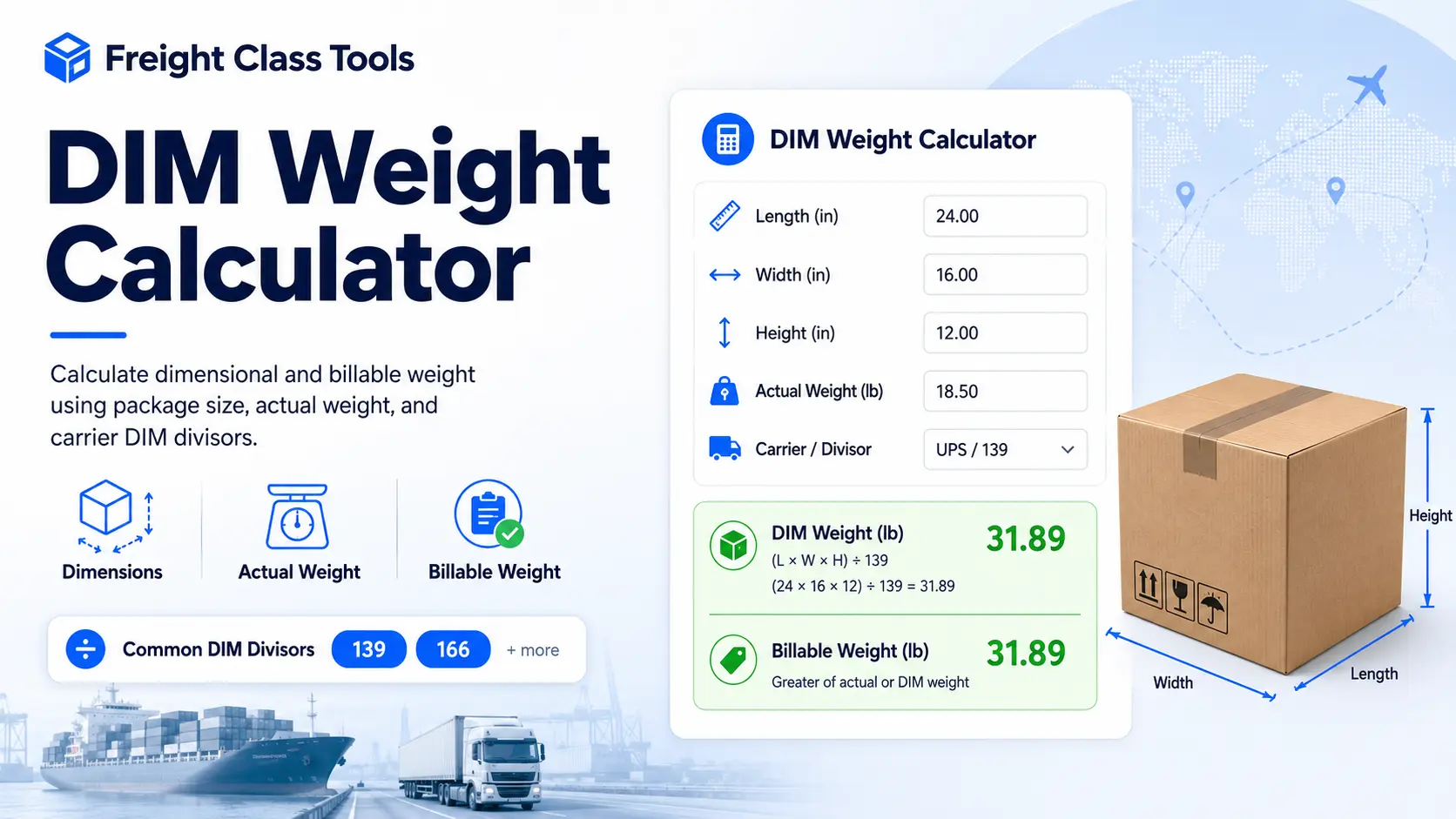
DIM Weight Calculator
Calculate dimensional weight from package size and compare it with actual weight.
DIM Weight Calculator
Our DIM Weight Calculator is an easy tool to help you determine the DIM Weight (or dimensional weight) of your package based on its dimensions (Length, Width, and Height). It also allows you to compare dimensional weight to your package’s actual physical weight. In seconds, you will know what the most accurate shipping cost may be for your shipment.
DIM Weight Calculator Steps
- 1. Choose your carrier or DIM divisor
- 2. Enter Package Length
- 3. Enter package Width
- 4. Enter Package Height
- 5. Enter Actual Package Weight
- 6. Select unit type for dimensions (cm or inches)
- 7. Click “Calculate DIM Weight”
Our DIM weight calculator will then display the package cubic size, the DIM weight, the actual package weight, and your estimated DIM billable weight.
What is DIM Weight?
DIM weight or dimensional weight is a billing unit used in the shipping industry. It’s a calculation that shipping companies and carriers, like FedEx and UPS, use as a basis for charging for shipments. DIM weight is calculated using the package’s Length, width, and Height, while shipping cost is generally determined by either the package’s actual weight or its DIM weight, whichever is higher. Therefore, large, lightweight packages may have a DIM weight higher than their actual weight.
DIM Weight Formula:
Basic DIM Weight Formula = Length x Width x Height / DIM Divisor
The DIM divisor may vary based on the service and the shipping carrier being used.
FAQs About DIM Weight:
No, a package’s actual weight is its real physical weight, whereas a package’s DIM weight is calculated based on its size or volume.
Shipping carriers use DIM weight as a way to account for the space that each package takes up in their vehicle. Large-sized packages that are not very heavy can take up a large amount of space in transportation.
A DIM divisor is essentially a term that’s used to calculate the package size into dimensional weight.
When using a DIM shipping system, carriers generally compare the actual and dimensional weights of a package and charge based on whichever is higher.
Yes, include packaging in your dimension measurements so you get accurate results. The measurements need to be the exterior dimensions of the packed box.