
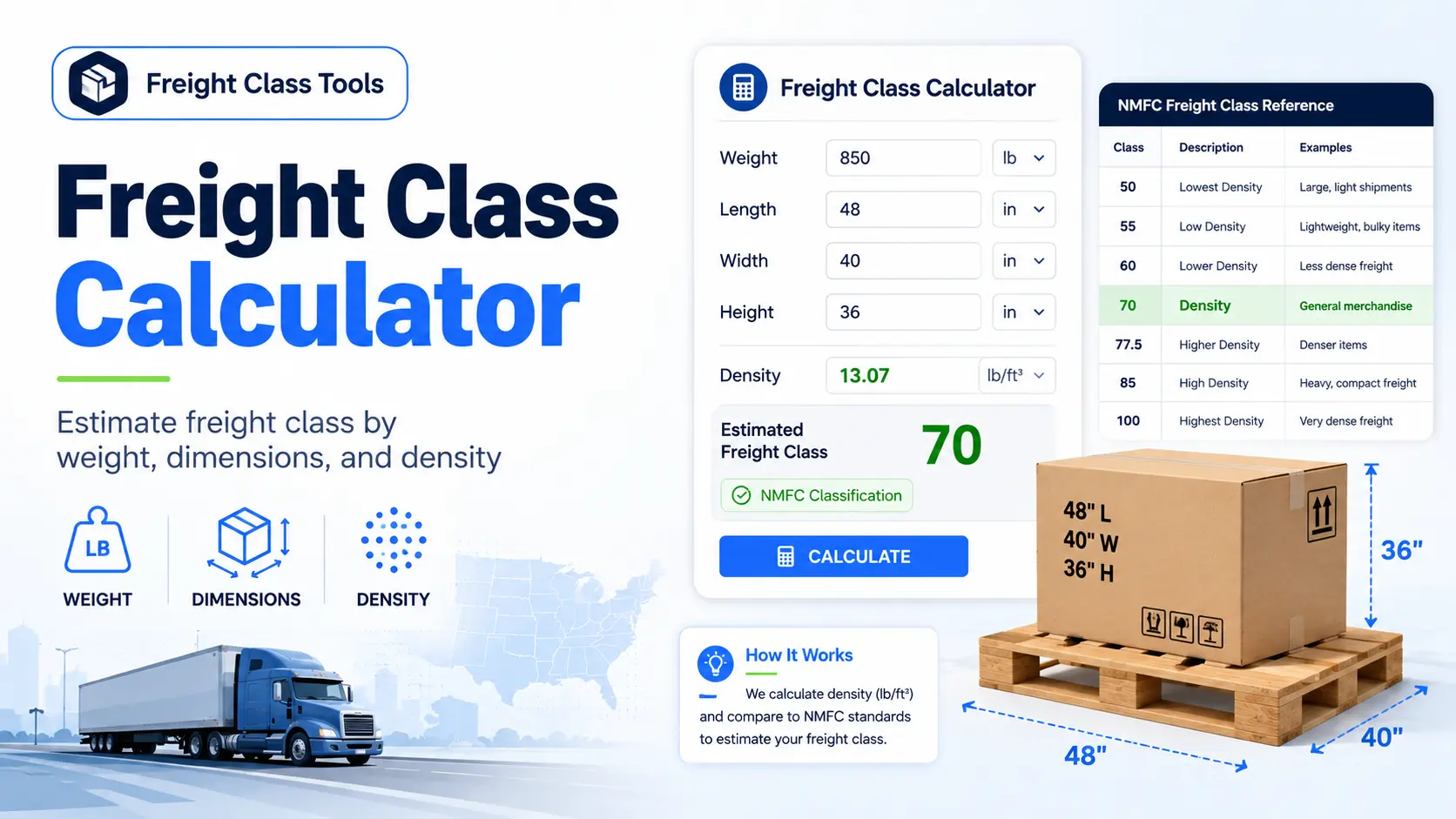
Freight Class Calculator
Enter the dimensions and weight of one handling unit to estimate its density-based freight class.
Shipment Details
This tool estimates a class from density only. Your carrier or the applicable NMFC item may determine a different class.
Freight Density Calculator
Calculate pounds per cubic foot for an LTL shipment.
Calculate density →DIM Weight Calculator
Compare dimensional weight with actual shipment weight.
Calculate DIM weight →Pallet Calculator
Plan pallet dimensions, volume, and shipment space.
Calculate pallet load →Freight Class Chart
| Density (lb/ft³) | Estimated Class |
|---|---|
| 50 or more | 50 |
| 35 to < 50 | 55 |
| 30 to < 35 | 60 |
| 22.5 to < 30 | 65 |
| 15 to < 22.5 | 70 |
| 12 to < 15 | 85 |
| 10 to < 12 | 92.5 |
| 8 to < 10 | 100 |
| 6 to < 8 | 125 |
| 4 to < 6 | 175 |
| 2 to < 4 | 250 |
| 1 to < 2 | 300 |
| Less than 1 | 400 |
Updated for current NMFC standards – Last reviewed August 2026.
Density is only one classification factor. Handling, stowability, liability, and the applicable NMFC item can affect the final class. Source: NMFTA 13-sub density structure.
Calculate in 3 Steps
Measure
Use the greatest straight-line length, width, and height of the handling unit.
Calculate Density
Convert volume to cubic feet, then divide weight in pounds by cubic feet.
Estimate Class
Match the calculated density to the current density guideline band.
Important Classification Note
Freight class is not always determined by density alone. The NMFC system also considers handling, stowability, and liability. Use this calculator as a density-based estimate and confirm the applicable NMFC item/class with your carrier or an official classification source before rating or tendering freight. The 13-sub density structure shown here is based on current NMFTA guidance reviewed in August 2026.
Updated for current NMFC standards – Last reviewed August 2026
Our calculator uses current NMFC density guidelines to estimate freight class. Actual freight class may also depend on handling, stowability, liability, NMFC item numbers, and individual carrier rules.
Source: NMFTA – NMFC Classification Guidelines
What Is a Freight Class Calculator?
This freight class calculator estimates the freight class of an LTL shipment based primarily on its dimensions, weight, and density. Our tool will help you create a carrier group shipment into standard categories. This method will help you handle requirements and shipping rates.
How to Use Our Freight Class Calculator?
To use our freight class calculator online tool, enter your shipment details according to the tool, including length, Width, height, Weight, quantity, and Correct Units, then click on Calculate Freight Class. After clicking on the button, the result will be shown in the estimated result: density in pounds per cubic foot, volume per unit, and total shipment weight.
How Is Freight Class Calculated?
Freight class calculator FedEx is commonly estimated by first calculating the shipment’s density. Density shows how much weight is packed into each cubic foot of space.
Use this basic formula:
Density = Weight ÷ Cubic Feet
To find cubic feet when measurements are in inches:
Length × Width × Height ÷ 1,728 = Cubic Feet
For example, suppose a pallet measures 48 × 40 × 45 inches and weighs 450 pounds.
- Volume: 48 × 40 × 45 = 86,400 cubic inches
- Cubic feet: 86,400 ÷ 1,728 = 50 ft³
- Density: 450 ÷ 50 = 9 lb/ft³
The calculated density can then be compared with the current freight class density guidelines to estimate the appropriate class. However, density is not always the only factor. The final NMFC freight class may also depend on the commodity, handling requirements, stowability, and liability. For this reason, our calculator provides an estimated freight class rather than an official carrier classification.
What Affects Freight Class?
The freight calculator is not just based on weight. Multiple factors influence the final class of an LTL shipment, such as weight, volume, and handling complexity.
Density
Density is arguably the most critical aspect when assigning freight class. It calculates the ratio between the weight of a freight shipment and the space it occupies. As a general rule, heavier, densely-packed freight shipments will result in lower freight classes while light-weight, voluminous freight will result in higher class.
Handling
Some shipments are more labor-intensive for carriers to handle than others. Fragile freight, has an awkward shape, or requires specialized equipment can be more costly and difficult to load or unload, and that’s why it’s taken into account for freight class determination.
Stowability
Stowability relates to how efficiently the freight can be stored or stowed inside the trailer alongside other shipments. Freight that doesn’t stack easily, is irregularly shaped, or utilizes excessive space can cause difficulties in being “stowed” effectively.
Liability
Carriers take on a degree of risk whenever they transport freight. If freight is high in value, susceptible to damage or danger, or generally fragile, it may be required to meet a higher standard for classification to offset the risks incurred.
Type of commodity
In addition to volume, the intrinsic nature of the product(s) will determine class calculator freight. There is the potential for separate and/or unique NMFC rules associated with many commodities that can result in shipments of similar density still receiving separate freight classes.
Consequently, it’s important to note that our online freight class calculator should be used only as an estimate and can serve as a quick reference tool to provide a likely indication of a freight class. However, the actual classification of any given shipment can vary based on commodity and carrier.
Why is this important in LTL Shipping?
In LTL shipping, an LTL freight class calculator is important because it helps us know what is being transported and what space the shipment is likely to take up during transit. It could impact your LTL quote. For instance, if the wrong class has been entered and is identified during shipment, we may be forced to review the shipment and class the shipment correctly. This could include extra fees and potentially larger final shipping costs. By ensuring your shipment details such as dimensions, weight, and commodity information are correct when preparing your shipment, you can avoid this entirely.
You will find that comparing LTL quotes is much easier when each quote has been based on the correct freight class; it helps ensure your cost is more in tune with the price you should be paying. If you are a business that ships more regularly than once in a while, you might find that learning about a shipping freight class calculator can also ease some of the stress. By being able to account for the estimated shipping cost, fill out the necessary documentation efficiently, and not worry about changes down the road, we know that learning and understanding a free freight class calculator could make your life easier!
Common Freight Class Mistakes
Spend an extra 5 minutes to double-check all of the details to ensure that you are quoted correctly and don’t face the unpleasant surprise of a freight bill later on.
Get the dimensions Wrong
Always measure the shipment as a whole, from the very outside edge of the pallet, container, or crate.
The Incorrect Weight Input
Always use the actual weight of the total shipment; don’t estimate. When you add in the packaging weight of the pallet, crate, or box.
Forgetting the Overhang
This usually goes overlooked. When boxes or product hang over the edge of the pallet, the total length and width must include the overhang.
Thinking Density Is Everything
When we talk about how density impacts freight, we really mean density IS important, but not the be-all and end-all in the freight classification factors. The nature of the commodity, handling, stowability, and liability ALL play parts too in determining freight class.
Just picking a Class Because
Some items have specific NMFC classes; using a density-related class without referring to the nature of the commodity can lead to higher rates and the potential for a freight class challenge later.
FAqs
Take measurements of the shipment including the length, width, and height. Determine how many cubic feet of space the shipment takes up, and divide that cubic feet figure by the weight of the shipment to get density. Use the density number to consult a freight class chart and to provide an estimate of class for the shipment.
A freight class calculator is a tool that estimates an LTL shipment’s freight class using its dimensions, weight, and density.
Class 70 freight is a common LTL freight category for relatively dense shipments. Under density-based guidelines, it generally applies to freight around 15 to under 22.5 lb/ft³, though the final class can also depend on the commodity and NMFC rules.
Freight Class 250 generally applies to low-density shipments weighing about 3 to under 4 lb/ft³. These items are usually bulky and take up more space compared with their weight.